
Winston Churchill once famously observed that “we shape our buildings and thereafter, our buildings shape us.” The statement suggests that buildings can provide the context within which people come together to create communities, to grow, to learn, to support one another, and to flourish.
Community is the social cement that binds people and holds neighborhoods together, and never was it more apparent – or necessary – than when world grappled with the global pandemic that forced us into social distancing, self-isolation, remote learning, and working from home.
COVID-19 left an indelible mark on society. The pandemic not only changed how we live our lives, it also impacted how we change and develop our communities in order to create more connected and sustainable residential neighborhoods.
Before 2020, emphasis was placed on the physical attributes of the built environment – the quality of the build, fixtures and finishes, need for green space, community facilities, and environmental sustainability. But Covid-19 spurred developers and urban planners to think more seriously about how to design resilient and self-sufficient communities that can self-organize, withstand, and respond positively to change. More attention has since been paid to the principals of designing and developing services and support structures that help residents integrate, agree on priorities, work together, and share common interests.
Focus on creating communities
Since then, the traditional bricks-and-mortar approach to developing residential real estate has changed significantly. Property developers have realised that they need to take the mental health and emotional well-being of their residents into account. Creating thriving communities involves far more than laying roads, proving infrastructure and building houses; it’s about providing balanced, nurturing environments where individuals and families can find purpose, self-actualize, connect, grow, and flourish.
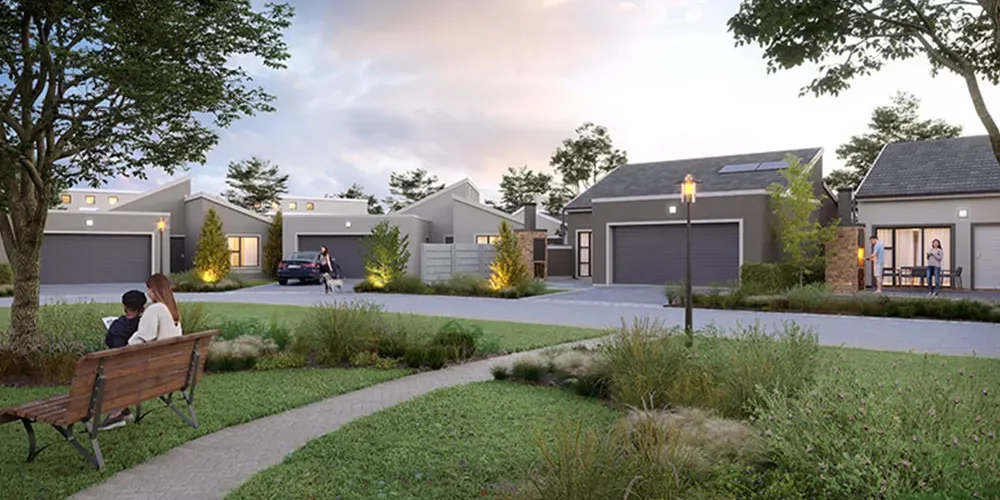
One of Port Elizabeth’s largest and fastest growing residential estates – Westbrook Country Estate – is a good case in point. Developed by the Amdec Group, South Africa’s leading developer of new urban lifestyles, this multigenerational lifestyle estate has been developed with a real sense of community at its core. A fully walkable environment dotted with ponds, playgrounds, and picnic areas, and crisscrossed with footpaths, jogging and cycle-tracks, Westbrook offers homes and communal areas that encourage social interaction along with an active healthy outdoor lifestyle.
Westbrook Country Estate is set on 128 hectares of lush parkland, teeming with birds and indigenous plant life. It occupies a prime location on Port Elizabeth’s western edge, conveniently close to retail and commercial nodes, offering easy access to major arterials, beaches, and PE’s central business district. The completed development will comprise nine residential estates, a bustling town centre with shops, restaurants, offices, and health clubs, a Curro Private school, and an Evergreen Retirement village.
In the wake of Covid-19, affordability and value for money became more important than ever. Buyers started looking for compact homes with good work from home potential and an excellent fibre-optic infrastructure so that they could stay connected with friends, family and colleagues via the internet and social media. Safety and security, low maintenance, lock up and go, and live-work-play convenience also became strong motivating factors. Given the deep societal challenges posed by the coronavirus, we are now encountering far more multi-faceted, multi-generational developments like Westbrook, estates that provide for the practical and emotional needs of their residents while delivering financial and occupational peace of mind and a host of world-class services, security features, facilities, and amenity.


